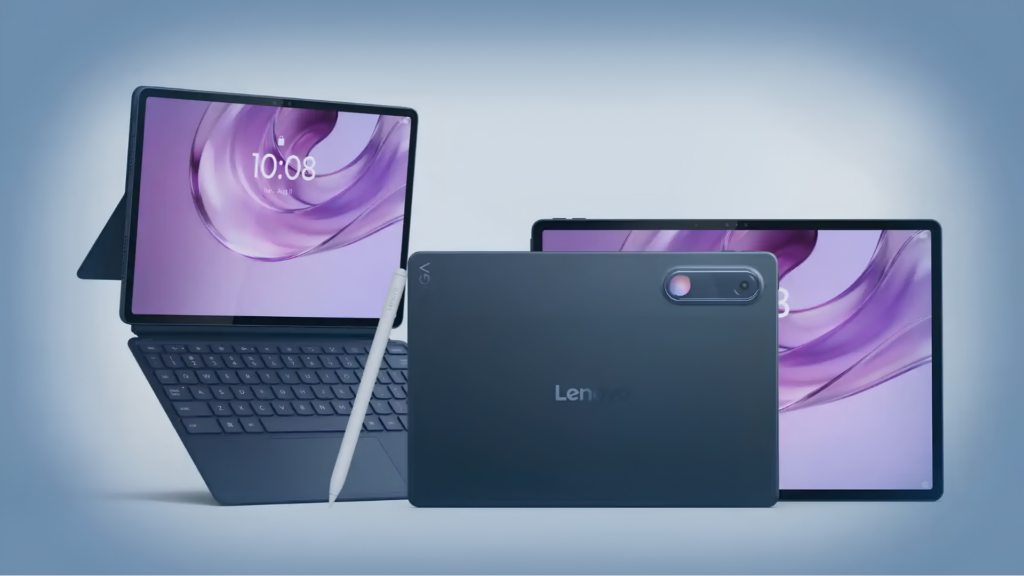

Lenovo has expanded its Yoga tablet range with two new models: the Yoga Tab Plus Gen 2 and a smaller, simpler Yoga Tab Gen 2. Both put a sharp 4K display and a long software support promise at the centre of the pitch. That is a sensible strategy in a market where Android tablets are often criticised for fading quickly after launch.
Two tablets, one design philosophy
The larger Yoga Tab Plus Gen 2 has a 13-inch PureSight Pro LTPS LCD with a 3840 x 2560 resolution. The 3:2 aspect ratio suits reading, browsing and document work better than the wide, narrow shape of many video-focused tablets. The refresh rate is adaptive and reaches 144Hz. Lenovo lists brightness at 700 nits typical and 1,100 nits at peak, with Dolby Vision support.
Inside is Qualcomm’s Snapdragon 8 Elite with an Adreno 830 GPU. Storage goes up to 512GB and can be expanded to 2TB with a microSD card, which is increasingly rare on premium tablets. Memory is where the source material is inconsistent. YugaTech’s summary says up to 16GB of RAM, while its detailed spec list says up to 12GB LPDDR5X. Until Lenovo clarifies, treat 12GB as the safer figure.
The standard Yoga Tab Gen 2 keeps the same 3840 x 2560 resolution and 144Hz panel in a smaller 11.1-inch frame. Peak brightness is the same 1,100 nits, but typical brightness drops to 600 nits. It uses MediaTek’s Dimensity 9500s, with up to 12GB of RAM and up to 256GB of storage, plus the same microSD expansion. An optional 5G modem is offered depending on region.
What sets the bigger model apart
The Plus model is the one for people who want a tablet to double as a laptop-style device. It has six Harman Kardon speakers, against four on the smaller tablet, which matters for video and music. It also has a 12,700mAh battery, versus 11,000mAh on the smaller model, and rear cameras of 13MP with autofocus plus a 2MP macro sensor. The smaller tablet has a single 13MP autofocus rear camera. Both have an 8MP front camera.
At 605g and 6.09mm thick, the Plus is slim for its size, though a 13-inch tablet will always feel substantial in one hand. The standard model weighs 480g and measures 6.2mm. The Plus comes in Cosmic Blue only, while the smaller model also offers Seashell.
The shared strengths
Both tablets share a lot. Each has Wi-Fi 7 and Bluetooth 6, a USB-C port rated at 5Gbps for charging and audio, and 68W wired charging. Each also has a three-point pogo pin connector for a keyboard, which signals that Lenovo expects many buyers to use them for productivity. The Plus has an optional All-in-One Clamshell Keyboard, and the smaller model has a 2-in-1 Keyboard Pack.
Both ship with a Lenovo Tab Pen Pro 2 in the box. Including the stylus is a welcome contrast to rivals that charge extra for it, and it makes the tablets more attractive to students and note-takers without raising the real cost of ownership.
Software support is the headline
The most interesting commitment is software. Both tablets launch on Android 17, and Lenovo promises seven OS upgrades, running until Android 24, plus seven years of security updates through 2033. For years, Android tablet buyers have had to accept far shorter support than iPad owners, so a commitment like this directly addresses a longstanding complaint.
Promises are only as good as the follow-through. Lenovo has a mixed record on update speed, and a long support window means little if each update arrives months late. Still, putting seven years on the spec sheet is a clear statement of intent, and it makes the premium price easier to justify if the tablets really last that long.
Who these tablets are for
The Plus is aimed at people who want a large, bright display for creative work, media and multitasking. The Snapdragon 8 Elite is a flagship chip, the speaker setup is generous, and the keyboard and stylus options give it flexibility. Anyone considering a high-end Android tablet as a laptop alternative will want to look closely at it.
The Yoga Tab Gen 2 suits buyers who want most of the experience in a lighter body. The 11.1-inch size is easier to carry and hold, the screen is just as sharp, and the optional 5G is useful for people who are often away from Wi-Fi. The trade-offs are the weaker speakers, smaller battery and single rear camera, which are reasonable for the lower price tier it presumably occupies.
What we still don’t know
Pricing is the biggest open question. Lenovo’s Philippine website lists both tablets as “coming soon”, but no local price or launch date has been announced. Without that, it is impossible to say how they will compare with rivals such as Samsung’s Galaxy Tab line. A strong spec sheet only matters if the price is competitive.
Other unknowns include real-world battery life, how well the 144Hz panel balances smoothness against power use, and how well Android 17 handles tablet multitasking. Reviews will answer these once units are in testing.
The bottom line
On paper, the Yoga Tab Plus Gen 2 and Yoga Tab Gen 2 are impressive. They pair 4K, 144Hz displays with current flagship-class chips, include a stylus, and promise seven years of updates. That last point could make them stand out in a category where longevity has long been a weakness. Whether they succeed will depend on pricing and on Lenovo keeping its update promise, and both will become clearer as the tablets reach more markets.